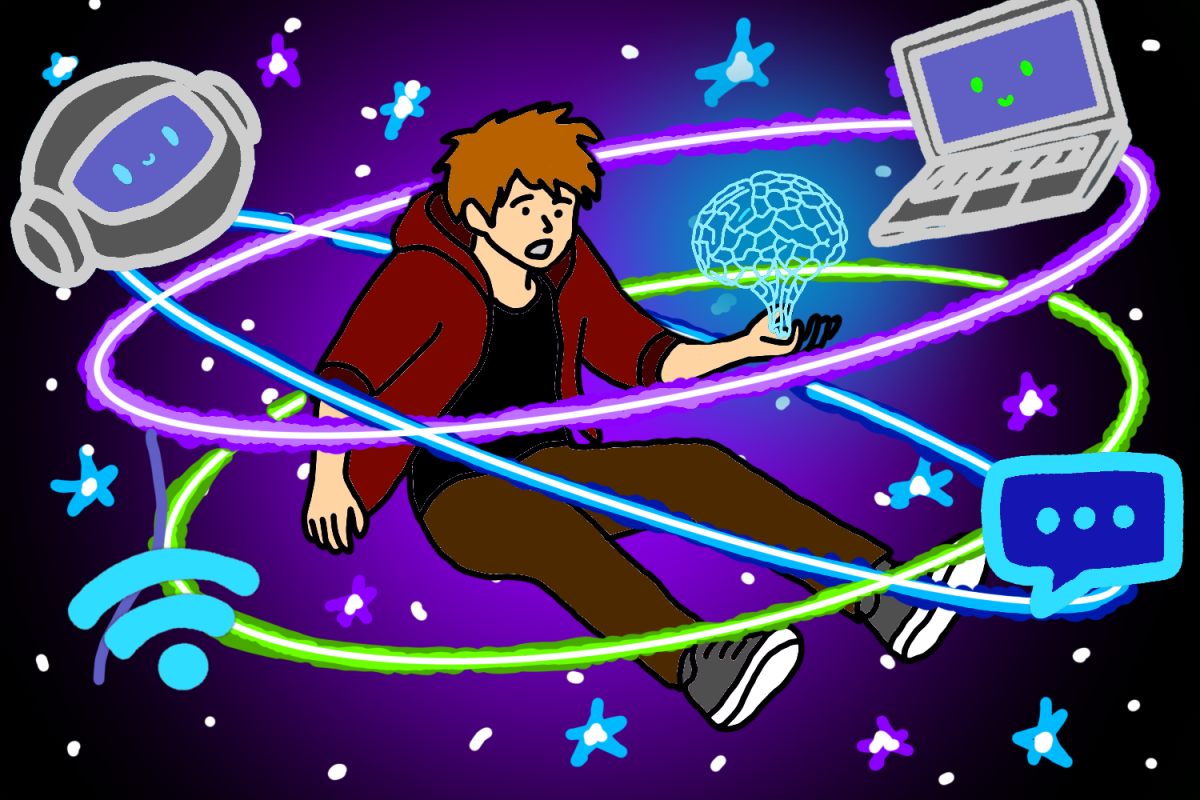
Artificial intelligence (AI) has quickly become a part of our everyday lives. From the algorithms on social media platforms to tools like ChatGPT that help students with their homework and schoolwork, AI has changed the way people learn and use technology.
Artificial intelligence is a computer program that simulates human intelligence by analyzing data and generating responses. Students at Arcadia High School (AHS) already use AI daily, especially tools such as ChatGPT, Claude, image generators, and recommendation algorithms commonly found on TikTok and Instagram. Because AI is already deeply embedded in society and education, schools should teach AI literacy to students so they can better understand how it works, the risks involved, and how to use it responsibly rather than depending on it entirely to complete schoolwork and homework.
Many students place too much trust in the responses that AI generates. Because AI produces seemingly confident answers, students may assume that the information is accurate. But despite how confident AI responses may sound, AI tools like ChatGPT can generate inaccurate responses or misinformation. AI generates responses based on patterns from data instead of truly understanding the information given to it, which can lead to incorrect information. A study conducted by the National Library of Medicine recorded that out of 115 references generated by ChatGPT, “47% were fabricated, 46% were authentic but inaccurate, and only 7% were authentic and accurate.”
Teaching AI literacy would help students develop critical thinking skills when determining whether a generated response is fabricated or authentic, a necessary skill in a world dominated by technology and AI.
A case study conducted by Camilo Jose Cela University shows that “more than 75% of students reported using methods considered unreliable,” demonstrating that students don’t care to evaluate the accuracy of their responses. As such, schools like AHS implementing an AI literacy unit would be effective in convincing students to start evaluating the accuracy of their responses.
One of the most obvious concerns regarding AI usage in education is the ethical problems that occur when students misuse it, such as plagiarism, misinformation, and overreliance on AI to complete essays and assignments. At AHS, there is no current specific policy that addresses the usage of AI; however, there is a policy on academic dishonesty. Traditional academic dishonesty rules won’t fully cover the problems regarding AI usage in AHS, which can confuse students on what’s acceptable. Therefore, AHS should establish guidelines on AI use and incorporate instructions into already existing courses.
Some students at AHS may submit completely AI-generated essays as their own work, which prevents them from developing and refining their writing and critical thinking skills. One survey indicates that one in five students often submit unedited AI content in their work. However, through a brief AI literacy unit students can learn how to use AI responsibly, such as using AI to brainstorm essay ideas or refining grammatical errors, both of which are ethical ways to use AI that minimize students’ reliance on AI.
Students who understand how to use AI will have an advantage in the workforce. Understanding AI and how it works will become a crucial skill for future jobs. Companies already use AI for data analysis, automation, and project management. Schools should prepare students for an AI-dominated future by integrating an AI literacy unit into core classes, such as incorporating one in freshman English or Modern World History, providing students a foundation for AI literacy that will continue to be reinforced in more advanced courses.