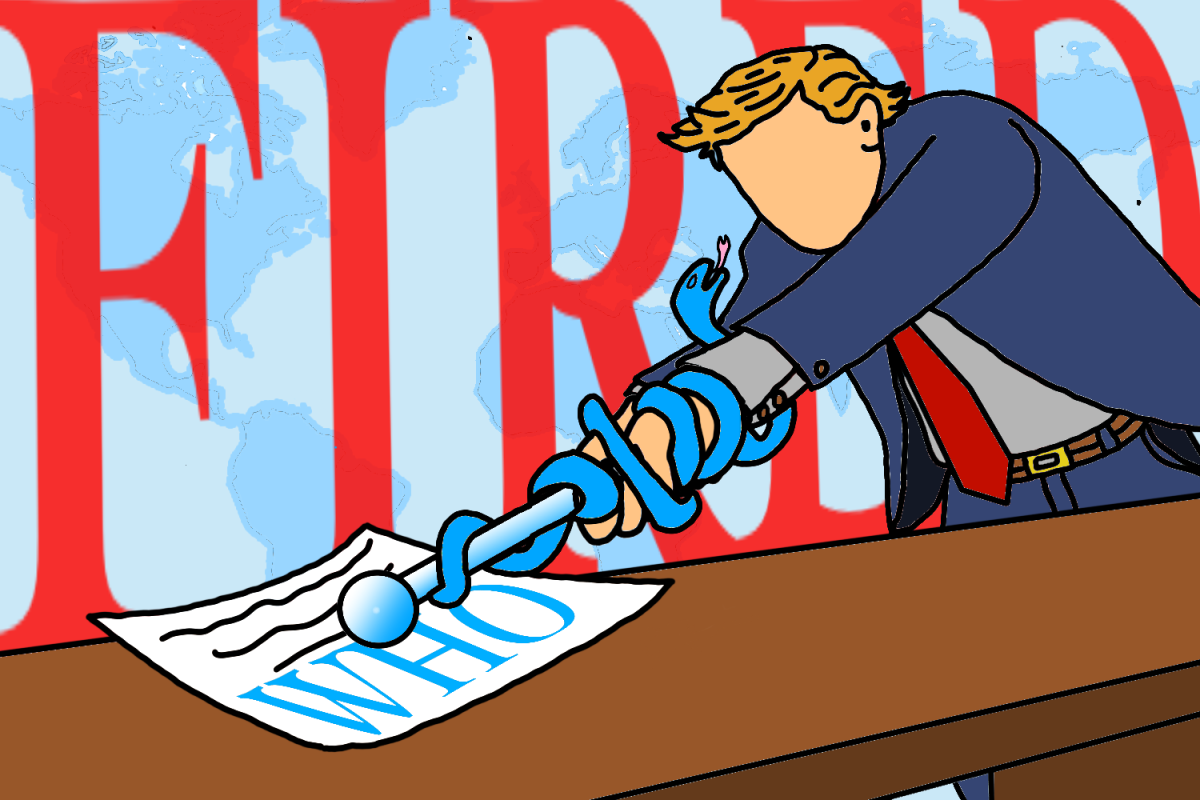
On the first day of President Trump’s second term, he signed an executive order withdrawing the U.S. from the World Health Organization (WHO). This order was highly expected since he attempted to withdraw from the WHO during his first term in 2020, but because the withdrawal requires a one-year notice, it was reversed by President Biden in 2021.
The WHO is a specialized United Nations agency established in 1948 that serves as an authority on international health. Its purpose is to promote global health, maintain safety, and serve vulnerable populations. The U.S. has historically been the largest contributor to the WHO since joining in 1948, viewing it as an extension of foreign policy to combat global disease and communism. By providing significant required and voluntary contributions to disease eradication programs and to stabilize developing nations, the U.S. used the WHO to extend its hand globally to promote American democratic values and serve U.S. interests as an expanding global leader.
However, with President Trump’s executive order that took effect on Jan. 22, the U.S. will no longer be able to expand American interests through the WHO. According to the White House, the main reasons why the U.S. withdrew from the WHO was due to its mishandling of the COVID-19 pandemic, its inability to demonstrate independence from the political influence of China, and its unfair financial burdens on the U.S.
The White House criticized the WHO for showing dangerous bias towards China despite China only funding a small fraction of what the U.S. funds. The WHO was accused of repeatedly parroting China’s assertions that the virus was not spreading through human-to-human contact despite evidence and warnings from a variety of sources. Additionally, the White House claimed the WHO delayed declaring COVID-19 a Public Health Emergency of International Concern (PHEIC) due to Chinese pressure, which prevented the timely implementation of global countermeasures and resulted in millions of deaths that could have been prevented. Moreover, the U.S. has long been the WHO’s top donor, historically providing more funding to the WHO than any other nation, typically 15-20% of the WHO’s total budget through required and voluntary contributions. In comparison, other top donors like the United Kingdom contribute only around 4-5%, and China, even less, contributes only 1-3%.
Although the White House’s criticisms of the WHO are valid, leaving the WHO may significantly shake U.S. soft power, the power a nation has to shape the preferences of others through its seductive culture, values, and policies, by creating a leadership vacuum for rival nations to fill, undermining the U.S. “benevolent” image, and forfeiting its influence on global policies.
As the U.S. withdraws from the WHO, other nations, especially rivals like China and Russia, are given the opportunity to fill the U.S.’s place. They’ll become the nations that influence the WHO’s policies and dominate the global platform while eroding U.S. influence. China, for instance, has already pledged $500 million in additional funding to the WHO over the next five years. This, combined with a 20% increase in their required membership funding, positions China to be the largest funder of the WHO. As the largest funder, China will assume a leadership role in global health, steering China in a favorable direction to govern as a global leader that rivals the U.S.
U.S. soft power relies on being viewed as a benevolent leader that shares wealth and saves lives of those less fortunate. By withdrawing from a global health coalition that combats disease and illness, the U.S. is dangerously signaling a “me-first” attitude, contradicting its reputation as a good-willed, collaborative leader in global health. The U.S. would be giving up influence, particularly in regions in Africa, where experts already worry about the growing influence of China. Moreover, the U.S. has provided billions in funding for HIV/AIDS, malaria, tuberculosis, and improvements in maternal and child health. Removing this support will result in a surge in cases and deaths, directly hurting the vulnerable and tarnishing the nation’s image as a “savior.”
Withdrawing from the WHO removes the U.S.’s seat at the decision-making table, allowing other nations–especially China–to shape global agendas and dictate global standards. By isolating ourselves, the U.S. loses a direct, influential role in setting international health policies. This means the U.S. has to follow standards set by other countries rather than leading them. The U.S. will become a follower–no longer a leader–on the global stage.
Soft power allows the U.S. to advance its foreign ambitions and secure national interests without resorting to military force. By shaping international debates and decisions, the U.S. can align outcomes with the nation’s interests. The withdrawal from the WHO is a soft power suicide. As U.S. soft power wavers, American foreign policy becomes less trusted on the world stage–and trust, once lost, is difficult to restore. Without trust, international cooperation becomes more difficult to secure. History, particularly during the Cold War years, demonstrates that it’s much easier to exercise world leadership with followers who willingly support a nation’s vision. Soft power is what makes that alignment possible. However, by withdrawing from the WHO, the U.S. stands at a dangerous cliff–one that threatens its grip in shaping and leading the world.