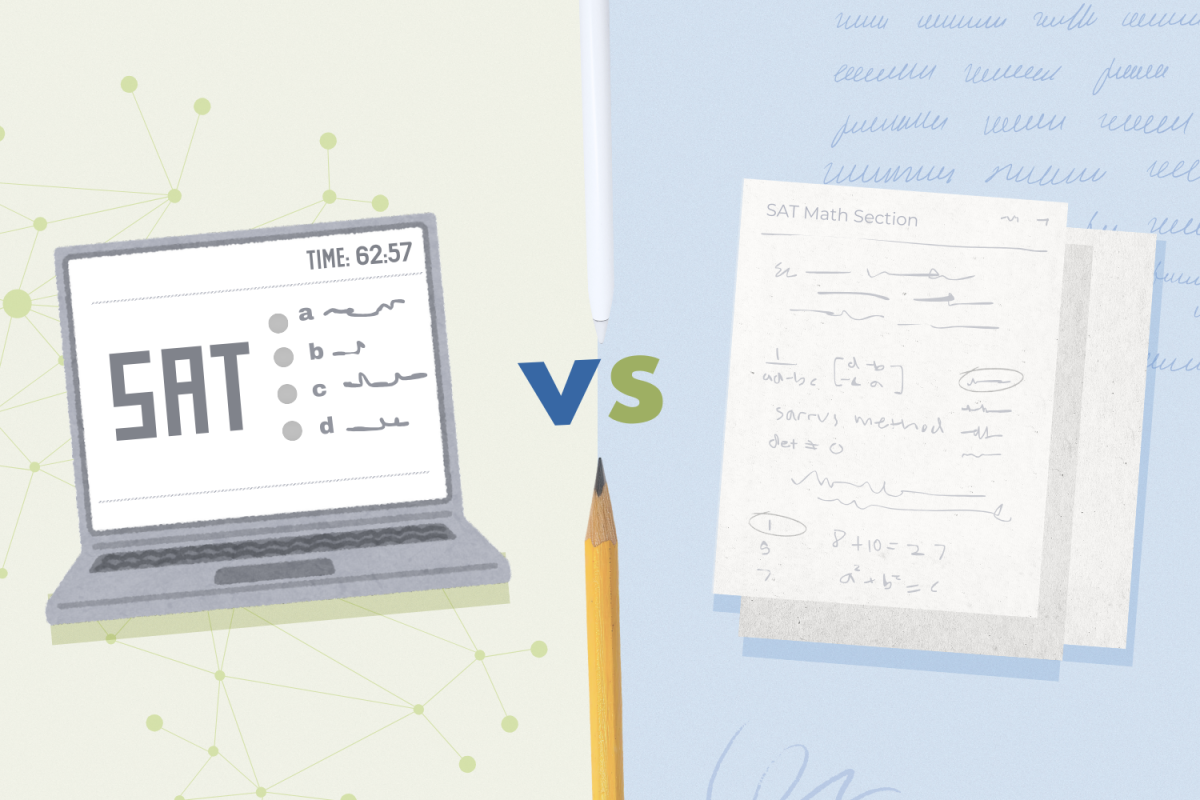
The shift of America’s college entrance exam from paper to digital happened during the COVID-19 lockdown. Even though it might seem modern and convenient, it’s secretly making the test harder. Although College Board has said the SAT hasn’t changed in difficulty, pointing to students’ familiarity with screens, the changes in structure introduce new problems that may make the test harder for some students. These changes affect how students read, manage time, and approach complex questions.
A key factor is the screen. Research shows that reading comprehension can be lowered when texts are digitally represented rather than on paper. A study comparing screen and paper reading found that readers consistently demonstrated better comprehension when reading on paper even though reading speed was similar across both. This suggests that students may understand key details more efficiently with printed text than reading digitally. On a test like the SAT where reading and analysis are essential, a small decrease in comprehension can alter performance and confidence. Though paper tests can be physically bulky and harder to organize, many students benefit from being able to annotate, underline, and track text more easily on paper.
In addition to the comprehension challenges, the digital SAT has a revamped structure. The new test is shorter overall, shifting from big and bulky articles to brief passages with single questions. While shorter passages may feel less intimidating, analyzing a complete article often allows students to understand better context, tone, and the author’s message. The new fragmented structure of the SAT forces students to constantly adjust between topics every question. Even though staring at a paper may cause fatigue, constant topic switching on a screen may increase mental strain and reduce focus even more.
The math section was also impacted by the digital format. The topics of algebra, geometry, data analysis, and trigonometry remain the same, but the structure and timing have changed. On the paper test, the math section was divided into a no calculator section and a calculator section, but on the digital SAT, calculators are allowed entirely, requiring students to decide when and how to use the built-in tools effectively. This can slow students down, disrupt their focus, or cause them to over-rely on technology for problems that could be quickly solved by hand.
The digital SAT is significantly shorter and paced differently from the original format. The total testing time was reduced from three hours to two hours and fifteen minutes, a 45-minute difference. These shorter time windows can increase pressure, especially for students who like to double-check answers or rely on careful reading. Additionally, the digital test can be adapted to adjust difficulty based on early performance, which can be a disadvantage for students wanting a near-perfect score. As a result, students who make small mistakes early or need more time to think carefully may be penalized more harshly, limiting their ability to achieve higher scores despite a strong understanding.
With the COVID-19 lockdown years over, it’s time for College Board to reconsider offering a paper version of the SAT. Even if paper tests require longer score processing, they could provide students with two different options to find one that best suits them.