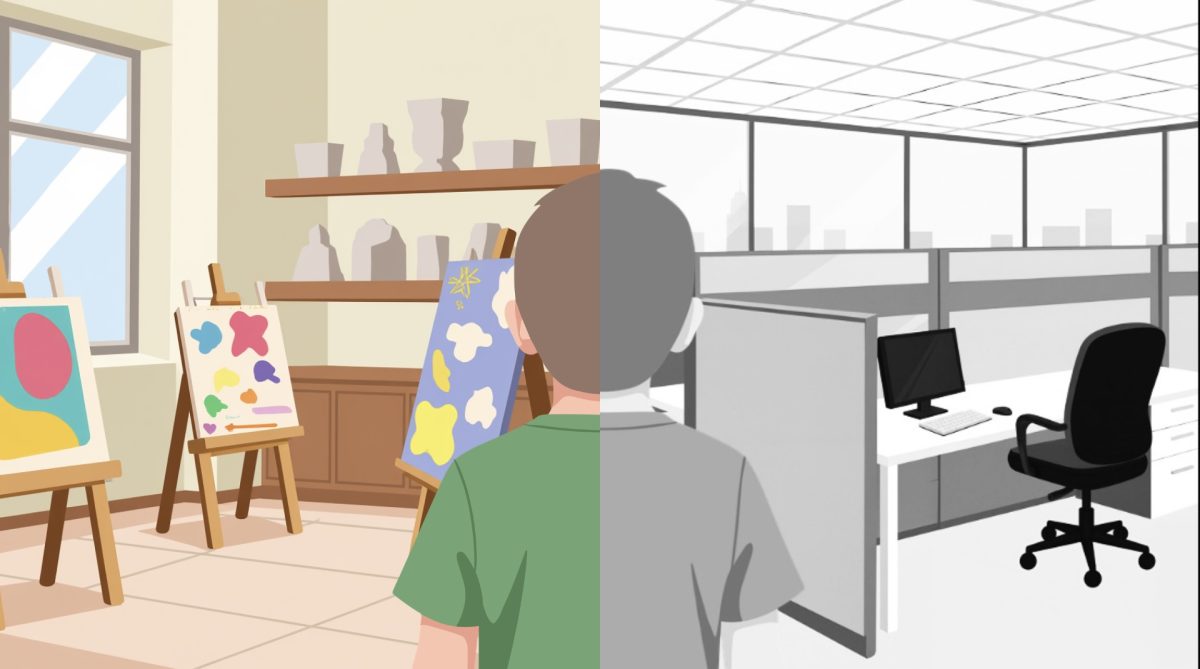
In a world obsessed with achievement, we often forget that success can take more than one form. And here at Arcadia High School (AHS), going to college isn’t just encouraged, it’s expected. Even worse, it can’t just be any college; it has to be one with minuscule acceptance rates, recognizable names, and one that looks good on a sweatshirt. These expectations from other students, parents, and social media have established that the college you attend is more than an education—it’s a status symbol.
There are legitimate options and paths besides a 4-year college that fit different people and goals. But why do we disregard them as subsidiaries?
Society today often views college as the sole option for post-high school education. In fact, choosing not to go to college is treated like a failure, something to whisper about and look down on. The college pipeline starts early: honors classes in freshman year, extra APs over the summer, after-school SAT prep courses, and constant reminders to do things to look good for college applications. Also, don’t forget—everyone is participating in a club, leading in an officer position, starting a nonprofit, joining an academic team, or building some kind of passion project.
And it’s not just fellow students creating the pressure. Parents add to this too: gossiping about whose cousin got a 1600 SAT score, whose nephew got into Harvard, and constantly comparing their children.
Yet, no one ever bothers to say out loud the simple truth: college is not the only option out there. At least, not a 4-year one.
There are countless other pathways that rarely get discussed with the same interest. Trade schools train students for the jobs that literally keep society running. Carpentry, electrical work, and cosmetology are just some examples of essential, well-paid careers that you can work toward with a trade school. Additionally, the average total cost for trade schools ranges from about $3,800 to $16,000, and they often take less than a year to complete. This number stands out in comparison to 4-year colleges, with the University of California schools averaging $43,000 to over $46,000 in costs per year.
Besides trade schools, some students can even go straight into the workforce or start a business through entrepreneurship. Another option is the military, which offers structure, financial support, and life experience that college can’t always provide.
And if you’re still interested in going to college, it’s important to consider the benefits of community colleges as well. They offer smaller class sizes, lower costs, and the ability to transfer into top universities. Additionally, many of the hands-on skills taught in trade schools are also offered at community colleges, like studying cosmetology at Pasadena City College.
When students are told that one sole path is better, they begin to measure themselves against an unrealistic standard. They feel ashamed for wanting something different, are pushed into pursuing a degree they don’t care about, or simply burn out. Not to mention, they’ll be buried under a pile of incurring debt.
It’s time to change that. We need to expand people’s horizons to these other options. We should make it easier to locate programs like mentorships with professionals in trades, internships with small businesses, and shadowing opportunities in different industries to help students discover what truly aligns with their interests and strengths. At AHS, we have already started this process by integrating career exploration into the high school curriculum. Students can choose to take elective classes such as Business Management and Work & Career Readiness in order to better prepare them for their future path. We also host trade school and military events alongside college events. For instance, the AHS College and Career Center will host the Career & Internship Expo on Feb 11, 2026.
But none of this will matter unless we also start to change people’s mindsets—both parents and students. Parents play a huge role in the pressure students feel, so it’s essential to share real stories of successful people who didn’t follow the traditional college route to help shift their common assumptions about what a “good” path looks like. When parents see that prestige isn’t the only measure of success, they’re more likely to support their kids’ choices and let them pursue paths that actually suit who they are.
Most importantly, however, are the students. Honestly, the hardest part is convincing them that these other paths are just as “cool” and just as success-inducing as a 4-year college. We’re so used to the idea that “impressive” means Ivy League-level difficulty that anything else feels like settling—even when it’s actually a better fit.
Post-high school success shouldn’t be defined by how impressive they sound. So instead of asking, “What college are you going to?” maybe we should start asking, “What future do you want to build?” At the end of the day, what matters is stability, happiness, and fulfillment. Yes, college can be a great path. But it’s time we acknowledge that it’s not the only one.