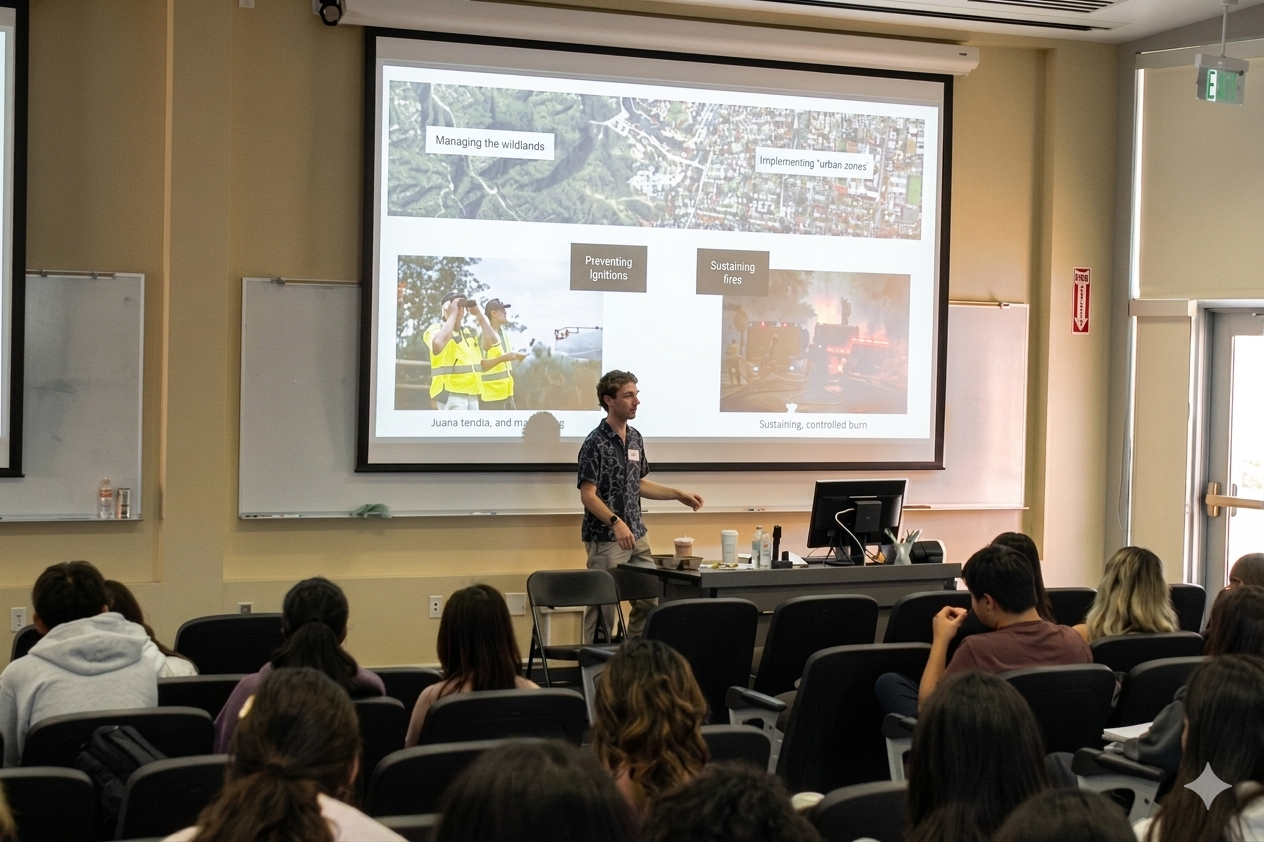
Los Angeles (LA) Times journalist Noah Haggerty visited the Arcadia High School (AHS) AP Environmental Science classes in the Lecture Hall on May 5. As a journalist centered in environmental and scientific topics, Haggerty discussed his experiences reporting on the LA wildfires in 2025 and covering the culture of indigenous tribes, as well as sharing his personal journey through writing.
Haggerty wasn’t always set on the path to environmentally-based journalism. In high school he took an interest in physics, without a single environment class in his schedule. He interned at the U.S. Department of Energy National Laboratories, located in Oak Ridge, Tennessee, where he debugged code. There, Haggerty realized he had a much better affinity for talking and writing about science than doing it. He began writing for smaller publications to jumpstart his writing career. Soon after, Haggerty wrote for the LA Times.
“I like science for three main reasons,” said Haggerty. “One, I think that we all have a right to access that feeling of wonder about how the universe works. Two, science directly impacts us in our day to day life.…And three, a lot of our taxpayer dollars go to funding science, and so I think we have a right to understand [where the] money is going.”
Haggerty spoke of the Palisades Fire in 2025, when he reported from the front lines. He witnessed the mass destruction the fires caused, from the burning rubble that was once homes, to the people worried about their loved ones still trapped in the fire, to the chaos the Palisades had succumbed to.
“It’s kind of cheesy, but it almost felt like the Upside Down from Stranger Things,” said Haggerty, adding that it used to be “this iconic stretch of highway [PCH] that I would take to go surfing, take my family when I was playing tour guide…I would know where I was, but nothing looked right anymore.”
The Palisades Fires was a devastating event that affected, and still affects, many who live in Southern California. 12 people were killed by the fires, as people tried to escape the inferno. Even when people did escape, over 6,000 homes did not, as the fire had burned them to the ground, leaving the survivors displaced.
Southern California’s current topography of shrublands and grasslands poses an even greater risk of fires. Invasive species of grasses grow quickly and burn faster. This is where prescribed burns and indigenous intentional fires, or cultural fires, come into play.
Through an interview with cultural fire practitioner Don Hankins, Haggerty learned that some tribal methods included burning “after the bees had pollinated in the spring to ensure that the bees would be okay and that the flowers would be able to grow. [They] would also intentionally burn around young willow trees, because…they grow very slender, and that was great for basket weaving.”
Haggerty introduced the idea that fire itself wasn’t the problem. The most destructive fires mainly result from a mass fear of fire, as individuals rush to snuff them out the moment they’ve started. In contrast, Haggerty noted how the indigenous population handled wildfires; letting smaller fires burn. California’s local wildlife is not suited to the large amounts of dense fauna on the forest floor, so when fire does inevitably arrive, the massive amount of shrubbery quickly lights ablaze in a fire that spreads too fast and becomes too destructive for firefighters to stop. The indigenous population, however, lit small controlled fires in order to reduce the amount of excessive flammable biomass.
The tragedy in the Palisades was not the only wildfire Haggerty reported on. In his 2024 article, “‘Truly random’ or sealed fate?”, he reported on mountain fires in Northern California, where one home would be burnt down and the next would stand perfectly untouched.
“It seemed so random,” said Haggerty. “There’s been this debate…how much control do we have over the homes that burn?…[I] got to talk with a lot of residents that were grappling with that question themselves and…a lot of experts that researched this.”
He added that with this article, it seemed as though he was “trying to intertwine a narrative…for the reader to follow, with this conceptual model of how [a] wildfire works.”
Environmental knowledge aside, Haggerty provided journalistic advice to AHS students striving to improve and develop writing skills. He explained how he found his own sense of voice when composing an article.
“Whenever I get stuck, (and I’ll get stuck often, especially on super complicated, scientific, ecological topics)…I will literally just imagine myself sitting in a coffee shop, explaining it to a friend,” said Haggerty, when asked about his own writing style. “Imagine you are truly just hanging out with your best friends, where your personality is showing most…write in that headspace. The more that you get yourself excited and try to communicate that excitement to a friend, the more likely the reader is going to feel that same passion.”
Finally, Haggerty advised aspiring student journalists and writers to “write as much as you can. Find publications, like the student newspaper or other magazines in college…just write for them. If you can’t find a specific publication, just start your own blog…and write about what you care about. Writing is very much a skill [where] the more you’re doing it, the better you’ll get at it, and you’ll lose it if you’re not doing it a ton.”
“Prioritize writing for publications, and especially if you can work with an editor,” Haggerty said. “You can get that really intimate feedback on your writing…Be as humble as you can; embrace all of the red lines!”