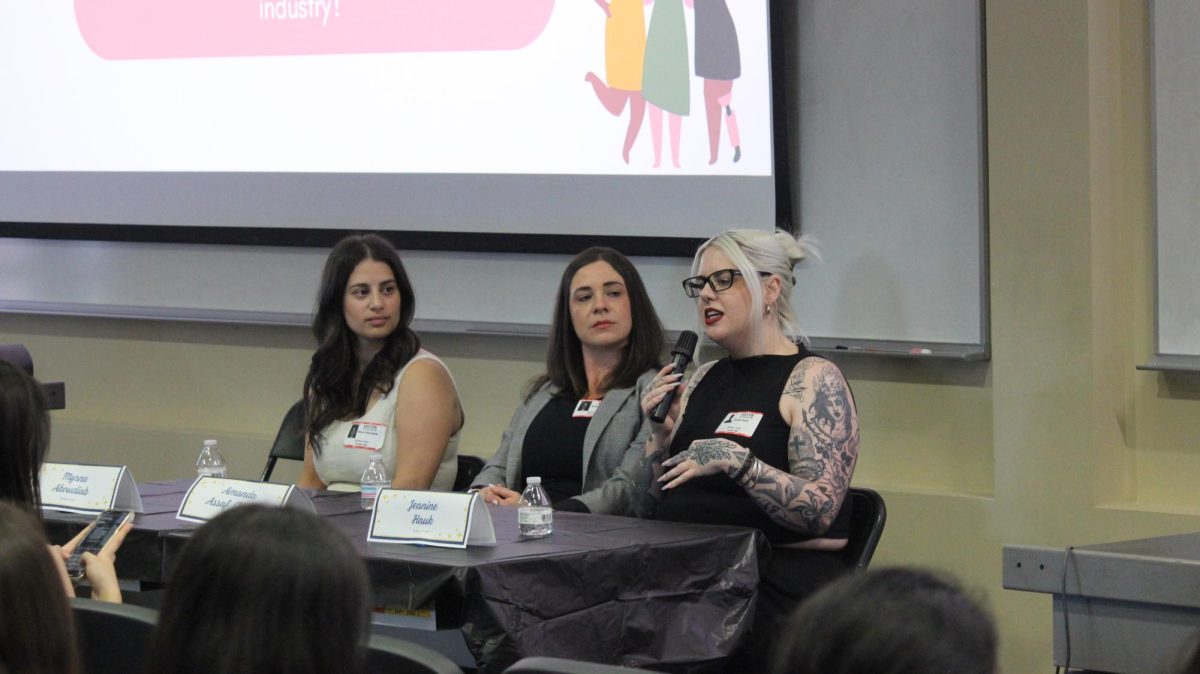
To celebrate Women’s History Month, the Equity, Diversity, and Inclusion (EDI) Club hosted a women’s panel in the Lecture Hall on Mar. 25 after school. They invited three guest speakers—Myrna Aboudiab, Amanda Assaf, and Jeanine Hauk—to share their experience as women in the workforce and inspire future generations.
Starting the event, the guest speakers introduced themselves and were asked how being a woman affected them in their workplace.
First was Aboudiab, a pediatrician who loves helping people and problem-solving. In her workplace, she said that some patients would refer to her as “nurse” or “miss,” even though she is a doctor.
“It’s a challenge to work your way up in medicine,” said Aboudiab as she reflected on her experience. She went on to share her own pathway in medicine, inspiring the audience with her independence and ambition.
The next to speak was Assaf, a nutritionist who loves the feeling of expanding impact. Assaf revealed that she had first wanted to become a doctor, but felt like a nutritionist suited her more in a sense that it involves helping people, food, and science. Similar to Aboudiab, she would get questioned about her role.
However, she said that “having that confidence and not letting it shake [her] and knowing what [she] brings to the table can be a strength,” while underlining that self-love is very important.
The last person was Hauk, a tattooist who loves the freedom to travel and be her own boss. She became a tattooist because of her love for art and self-expression. After realizing that corporate jobs didn’t suit her, she became an apprentice and worked her way up to obtain the freedom she currently has. She emphasized that the tattoo industry is a very appearance-orientated industry.
“How people represent themselves in the tattoo industry is very important, especially for women,” said Hauk, “Getting to the place I am now is very hard, I have to overextend myself [to be seen]; it’s a tricky game.”
Following that, the three guest speakers shared the experience of many people misunderstanding their jobs.
For example, as Aboudiab works, her mind is running through many different things to figure out what is wrong with her patient. Conversely, many people think that doctors can fix everything in one go, when in reality, one minor issue can always snowball into a larger problem.
Similarly, Hauk further expands on her job and how people think it’s easy.
“Tattooing only works if you are obsessed with it. I go to work and tattoo for eight hours [and] I go home to do homework, and then I have a doctor’s appointment the next day…on top of being an artist, you also have to be able to advertise yourself,” she said.
Afterwards, EDI took the microphone to ask each of the guest speakers individual questions regarding their personal experiences and jobs.
Assaf was asked about how social media affected her opinions on nutrition and helping her patients find a common ground to reach their nutrition goals.
“There are a lot of misunderstandings in social media and people get defensive over what they see,” said Assaf, emphasizing that getting her patients to trust her was important.
When the three speakers finished answering their individual questions, EDI encouraged the audience to ask questions to know more about the speakers.
There was a question about the speakers’ thoughts on microfeminism—small, everyday, and intentional actions taken to challenge gender bias and inequality, often in workplaces and personal life.
“I heard a lot about microfeminism when kids get sick at school…they call the dad first and they’re not assuming that the mom is the primary person to call,” said Aboudiab, regarding how people are starting to adapt to have gender diversity in this generation.
“I definitely see the divide and conquer happening between masculinity and femininity…I just feel like in general if we just accept people for who they are and choose love every time…I think that’s the best route to go,” said Hauk.
Overall, the event ended with smiles and picture-taking with many staying afterwards to ask additional questions. The panel was able to create an engaging atmosphere, broadening everyone’s perspective on women.