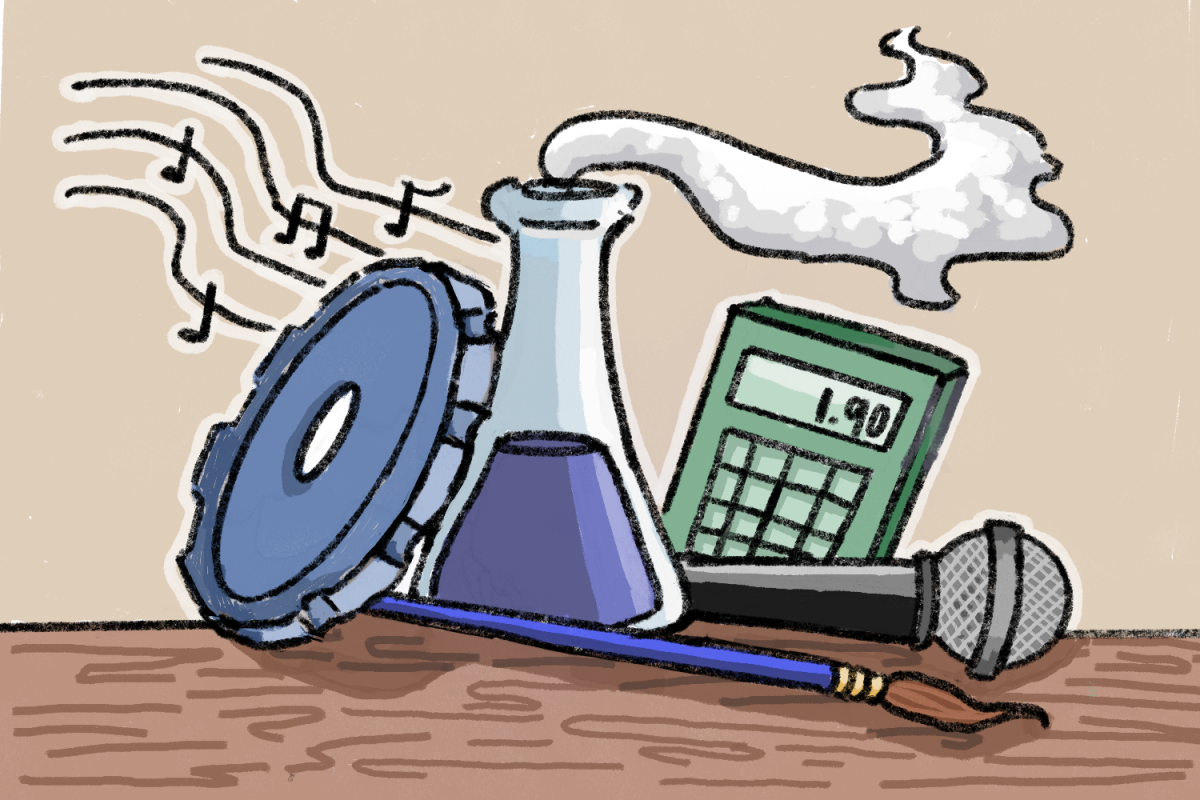
During these important years, many Arcadia High School (AHS) students feel the burden of the future–deciding which classes to take, what job they should pursue, and where to apply for college. Although these decisions are exciting, some students feel pressured because these choices have such a major impact on their future. One obstacle many students encounter is choosing between following logic and their genuine interests. Namely, students must consider whether their interests could lead them to a job that addresses long-run problems, such as financial stability and job security. However, studies indeed found a connection between childhood hobbies and career paths. For example, some students believe that what they loved as a child has had an important impact on their academic and career goals.
First of all, many factors exist when a person first starts identifying interests, and one of them is consistent engagement.
“During [COVID-19], I would always look forward to finding a Tinker Crate on my doorstep. Each had a unique activity, and I loved the process of building and completing them. If anything, now I want to be an engineer,” said sophomore Sarah Chou.
For Chou, granted the opportunity to work with Tinker Crates—crates that introduce engineering through hands-on projects designed for children–reflected her natural affinity for problem-solving and engineering. Because Chou was able to feed her brain with new puzzles to solve, her hobby gradually turned into a skill that can become useful in careers that would require those abilities, such as engineering, science, technology, engineering, and mathematics (STEM) fields.
Another important factor is outside influence and accessibility. Because the world is filled with an endless number of opportunities, the unknown can be quite terrifying to children. The people around them and the environment have an important role in shaping career aspirations. Being with an experienced adult, especially someone with strong emotional ties, bridges the gap between the unrealistic and the realistic. In most cases, family members help navigate a dream, such as sophomore Kayla Sy’s mom. Science museum visits with her mom not only cultivated interest but also unknowingly built confidence and familiarity. Dreams can feel far and otherworldly, but experience and early exposure have a large impact on pursuit, making them feel reachable.
“As a kid, my parents would take me to visit science museums such as the Discovery Cube, which fostered my love for STEM. As of right now, I want to be an epidemiologist like my mom,” explains Sy.
“My parents put me in an art class, and through the many years I was in this program, a specific teacher I had inspired and made the love I have for the arts flourish. It put me through the troubling decision process as I had to pick between sticking with what society deems as correct and what I want to do. So I really admired my teacher and want to do the same to help others learn art,” states junior Camila Pinero.
Demonstrated by Pinero is the effect of the environment; even though these aspirations exist in childhood, it is up to us to uphold it. Especially, emphasizing the importance of encouragement. Pinero’s teacher became a pivotal figure in her commitment to pursuing art seriously and encouraged her to follow her heart. Her advice to pursue passion regardless of other factors highlights the importance of finding happiness rather than focusing on money.
All in all, although childhood hobbies can’t always predict the future, they are important to consider as the foundation for skills, values, and confidence. Something from childhood may seem small, but the experiences gained are meaningful.